

THANK YOU FOR SUBSCRIBING

Insurance CIO Outlook Weekly Brief
Be first to read the latest tech news, Industry Leader's Insights, and CIO interviews of medium and large enterprises exclusively from Insurance CIO Outlook
A featured contribution from Leadership Perspectives, a curated forum for finance technology leaders, nominated by our subscribers and vetted by the Insurance CIO Outlook Editorial Board.


Artificial intelligence (AI) is rapidly becoming part of insurance application processing, but many carriers are still figuring out how much of the process can realistically be automated and where to start so that they can move out of pilots fast and scale well.
Insurance CIO Outlook spoke with Vital Soupel, a Senior Insurance IT & AI Consultant at ScienceSoft, who has been helping insurers transform underwriting workflows since 2021. He shared his perspective on what application intake use cases insurers should focus on if they want to realize AI value over the next 6 to 12 months.
Where do you see the biggest near-term opportunity for AI in insurance application processing?
Vital Soupel (VS): Agentic AI can orchestrate the operational side of application processing, from submission intake and document review to workflow routing and underwriting preparation. That’s where I see the largest opportunity.
Currently, the highest hidden cost in application processing is delay. In many organizations, underwriters are spending hours daily reviewing submissions, reconciling data across documents, chasing producers for missing details, and moving between systems just to assemble a complete view of the risk. Each small extra step adds processing time and hampers conversion, producer experience, and underwriter capacity.
While traditional OCR-RPA tools can still effectively read and pull data from documents, they stop after the data is retrieved. In contrast, systems built on agentic AI can understand and automate submissions as a whole. They can process documents, identify gaps, summarize the risk, handle communications, and even decide on eligibility and price in simple cases.
Early adopters of application processing AI report intake timelines compressed to minutes and quotes issued more than 4x faster.
Which steps of application processing can be automated through AI now?
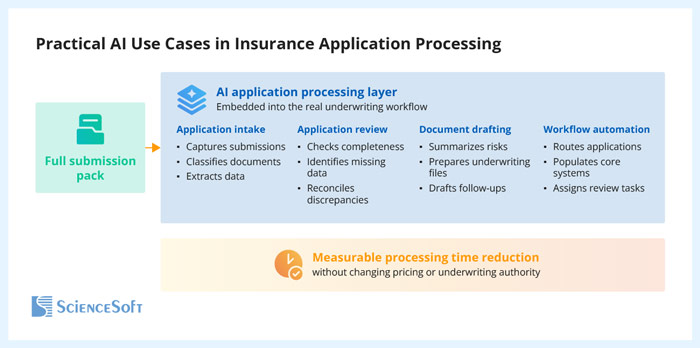
VS: AI is definitely ready to handle the first half of the application processing pipeline. It can capture and triage applications, extract fields, summarize submissions, check completeness, prefill data into systems, and draft follow-up questions for producers and customers. These are high-volume activities that consume skilled people’s time but require little underwriting judgment.
Where I’d be more cautious is final eligibility, risk scoring, pricing, adverse decisions, and anything that directly affects customer or business outcomes. AI can support those areas, but the liability is much higher. You need strong governance, explainability, and human oversight to defend AI decisions to applicants and regulators.
Can insurers realistically achieve straight-through intake with AI in 2026?
VS: It’s realistic, but only in narrow cases. It can work if the submission documents are standardized, the risk is simple, the confidence scores are high, and the business rules are clear. Basically, minimized guesswork. This is possible in standard personal auto and homeowners lines, parametric weather, and small commercial products.
In many of these cases, straight-through processing isn't new, and decisioning is already automated through rule-based engines. AI improves how submissions reach those engines by handling documents, preparing validated data, and orchestrating handoffs.
But for complex commercial, specialty, and L&A products, a more realistic goal is straight-through preparation.
That means AI prepares the file so the underwriter can make a better decision faster. It organizes the documents, extracts data, flags what’s missing, summarizes the risk, and recommends where the case should go next. The underwriter still owns the decision. ScienceSoft’s commercial insurance clients I discussed AI-powered submission intake with agreed that this model better reflects how P&C commercial lines of business operate.
Source: AI in Insurance Application Processing, ScienceSoft.
This is also why I don’t believe AI will eliminate the underwriter’s role in any complex commercial or specialty insurance environment. The most reliable near-term AI value in these domains comes from an assistive pattern: AI drafts, humans decide. That utilizes AI’s productivity while preserving human accountability where it matters.
Insurers commonly expect AI to reduce application processing costs. Is that the right way to think about ROI?
VS: I would be careful with how ROI is framed. Reducing operating costs is possible, but in many of the projects I led, the financial benefit first appeared as cost avoidance. With AI, teams could handle more submissions with the same number of people — reducing operational pressure on underwriters and support staff and allowing for business growth without adding headcount.
The first measurable outcomes are usually faster quote turnaround, higher underwriter capacity, fewer manual touches per submission, and lower rates of not-in-good-order (NIGO) applications. Those improvements tend to appear much sooner than direct labor savings because they don't require organizational restructuring to realize value.
Longer-term business outcomes can come from better risk selection and loss ratio improvement, when AI helps identify appetite mismatches and surface risk signals. However, it’s a much harder objective because, as I said, it requires very careful governance. Before AI can influence underwriting decisions, you need evidence that its simpler outputs are accurate, explainable, and consistently perform well in production.
If you were advising a midsize insurer starting with AI in application processing today, what would your pilot look like?
VS: In ScienceSoft’s engagements, I usually recommend that insurers pick one product line and begin with the intake automation use cases. They’re measurable, they’re close to daily pains, and they don’t touch high-impact decisioning. The goal should be to demonstrate that AI can improve one important workflow, making it faster, more accurate, and more scalable. Once you prove accuracy, workflow impact, and user adoption, you can gradually expand into underwriting decision support.
The pilot should run on real submissions in parallel with the current, human-led process. That lets you fairly compare the AI vs. human efficiency and determine AI processing gaps early on. Evaluate AI using standard indicators like intake cycle time, extraction accuracy, NIGO rate, and producer impact for unified assessment. Metrics like user adoption rate, escalation rate, and override rate will give you an idea of the AI’s value for your underwriting team.
From my experience, 10 to 12 weeks of a pilot run is usually enough to validate the AI business case and operating model. After that, you can move the working pilot to production and proceed with AI scaling to the next workflow.
